The concept of working remotely has risen over the last couple of years. Whether it is staying at home, booking a coworking space, sitting in a
coffee shop, or videoconferencing from the nice terrasse of an Airbnb...One thing is for sure: the office building is far from being the only
place where people can work and thrive. Employees are no longer location-limited. So, what is the office of the future?
This shift implies many changes for companies, both positive and negative. Versatility is key to adapting to the trends of the future of work
and succeeding in this new era based on flexibility. While the purpose of the office evolves, its design also adjusts to our new ways of working.
It is not only about furniture and layout arrangements but also about the psychological and emotional impact of our surroundings.
When picturing the office of the future, expanding your perspective beyond bricks and mortar to embrace digital transformation and more flexible
work arrangements is key. Advanced technology, such as virtual reality (VR) solutions, 3D tools, and the concept of the metaverse, reinvent the
concept of the traditional office. These innovations allow for the creation of interactive environments that can simulate physical presence and
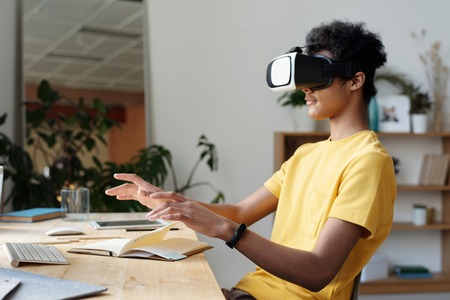
enable real-time collaboration across multiple locations, as if all participants were in the same room. Imagine putting a VR headset on and
finding yourself in a boardroom with your global team. You discuss projects with your colleagues’ avatars, manipulate 3D models of products
with precision, and make decisions as if you were face-to-face. This is the profound potential of the virtual office.

The Meeting Rooms of the Future Create an Immersive Experience
Meeting rooms of the future are likely to become advanced hubs of collaboration, where the distinction between in-person and virtual presence blurs.
The importance of creating an immersive meeting experience stems from the necessity to integrate remote staff with those who are physically present
seamlessly. This fosters equal participation and ensures that no one is excluded. In the future, a wide range of workplace technologies will be employed
to enhance interactivity and communication between on-site and remote team members.
Another key aspect of the meeting rooms of the future is their high-resolution displays wrapped around the physical space. This allows a 360-degree
view of remote team members and content and simulates a unified team sitting at the same table. Meanwhile, advanced sound systems deliver directional
audio, which makes it easier to discern who is speaking. In these rooms, augmented reality (AR) brings digital information into the physical environment,
and employees can collaborate using virtual objects and data. Meanwhile, virtual reality (VR) technology can be used to enable participants to join from
anywhere in the world in a fully realized digital conference room.
Undoubtedly, Artificial intelligence (AI) has a big role to play in the office of the future. It facilitates meeting logistics, automatically handling
scheduling, transcribing discussions in real-time, translating languages, and even suggesting action items to streamline follow-ups. Interactive whiteboards
and touch screens ensure that annotation and brainstorms can happen dynamically, with changes visible to both remote and local participants. Therefore, these
future meeting rooms are a powerful fusion of technology and human knowledge, enhancing collaboration and driving productivity regardless of geographical
constraints.
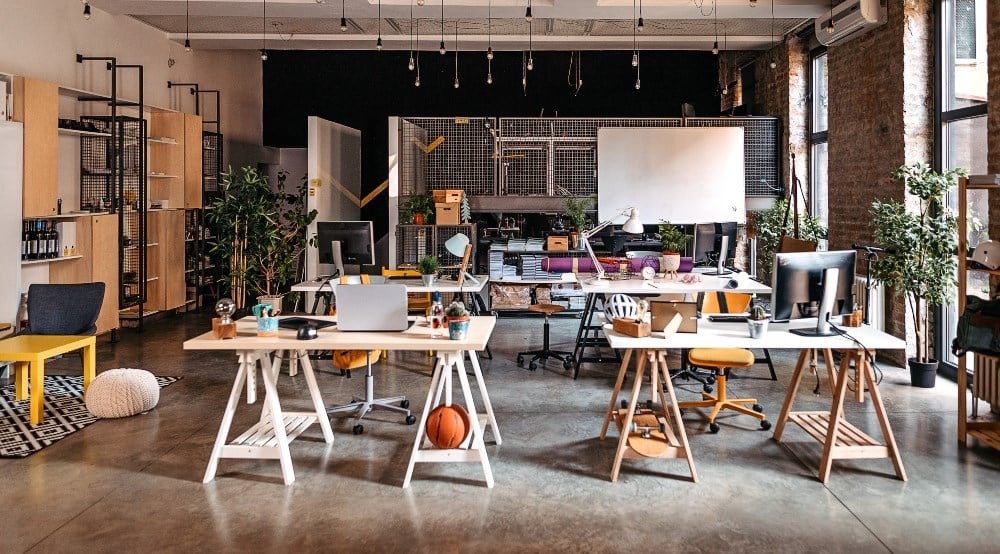
The Workplace of Tomorrow is Tech-Savvy
If you’ve read this far, you probably understand the immense influence technology has in the office of tomorrow. It is not merely a space equipped with digital
tools, it is also fundamentally defined and enhanced by it. Advanced technology plays a crucial part in cultivating a healthy and efficient work environment.
For instance, smart climate control systems ensure optimal temperature and air quality, adjusting in real time to occupancy levels and external weather conditions.
Lighting systems that mimic natural light patterns can promote well-being and boost productivity, too. Ergonomic furniture with embedded sensors monitor and encourage
good posture among employees.
Technology enables efficient workspace management in the office of tomorrow. Internet of Things (IoT) sensors can monitor space utilization, leading to an optimized
office layout and the widespread adoption of systems like hot desking. Resource booking platforms like deskbird streamline the allocation of desks and meeting rooms
in real-time, reducing wasted space and friction in scheduling. The blend of these technologies produces a workplace that is both functionally advanced and human-centric.
It creates an environment where employees feel and are supported, secure, connected, and inspired to innovate. This tech-savvy physical space predicts a future where the
office is a smart ecosystem tailored to the shifting dynamics of the world of work.
 VENKY
VENKY